Special Memory Operation.
Celebrating Russia on the Eve of the War.

Photographs & text by Jean De Sousa.
On the morning of February 23rd, 2022, a thin blanket of snow covered the rugged paths winding between the graves at Antakalnis Cemetery in Vilnius. Here, the dead rested in peace, for the soothing silence was only occasionally broken by cold gusts of wind blowing through the branches of the trees. Antakalnis possessed all the scenic qualities to please living souls in search of a picturesque escape from central Vilnius. Tombstones from different eras are scattered seemingly at random across the hilly terrain, most bearing the names of individuals who led unassuming lives in Polish, Soviet, or Lithuanian Vilnius. Not everyone here perished anonymously. In 1991, Moscow unwittingly offered several martyrs to the cause of independent Lithuania in the form of innocent civilians and border guards shot, beaten, or crushed to death in a vain attempt to prevent independence. Their graves are arranged in a modest yet solemn memorial composition drawing much from religious imagery, something not surprising considering that the state funeral ceremony of the slain border guards in 1991 marked the sudden return of religion in official events. A few hundred meters away from the martyrs of 1991, concealed behind a thick concentration of trees, lies another plot of hallowed ground under which rest the victims of a very different struggle: the Red Army liberation-cum-occupation of Lithuania.
At first glance, it appeared that few mourners and even fewer curious wanderers had gathered the courage to leave the comfort of their homes to come to Antakalnis this morning. But the apparent emptiness of the cemetery was deceptive. In sharp contrast to its surroundings, the Soviet memorial, standing slightly isolated atop a mound surrounded by thick trees, was buzzing with a life of a peculiar kind. A group of highly motivated locals had braved the elements and converged there to perform an annual ritual they had certainly practiced for decades: the celebration of Defender of the Fatherland Day at the Antakalnis Cemetery Soviet memorial. The whole memorial complex could not have been better suited to accommodate grandiose gatherings. Inaugurated in 1986, long after Soviet architects and sculptors had mastered the evocative power of perspective and abstraction, it consisted of six oversized and highly stylized Red Army soldiers standing proudly at the end of a long ascending path flanked by the graves of 3,098 fallen Red Army soldiers. The harsh, vaguely cubic features of the fighters gave them a striking dourness that conveyed the horror of war with impressive conviction. Not a few children must have been frightened at the sight of these granite monsters. Of course, the location was absolutely perfect for celebrating Defender of the Fatherland Day, not least because this was the last remaining Red Army memorial in Vilnius.
The gathering consisted of about forty elders, accompanied by a few middle-aged men and several journalists. They had just finished the wreath-laying ceremony at the base of the monument. As they prudently walked down the icy steps leading back from the monument to the main part of the cemetery, one of the younger men took the lead and gently but firmly conducted the group by issuing orders in Russian:
“Davaite, tovarishchi!”
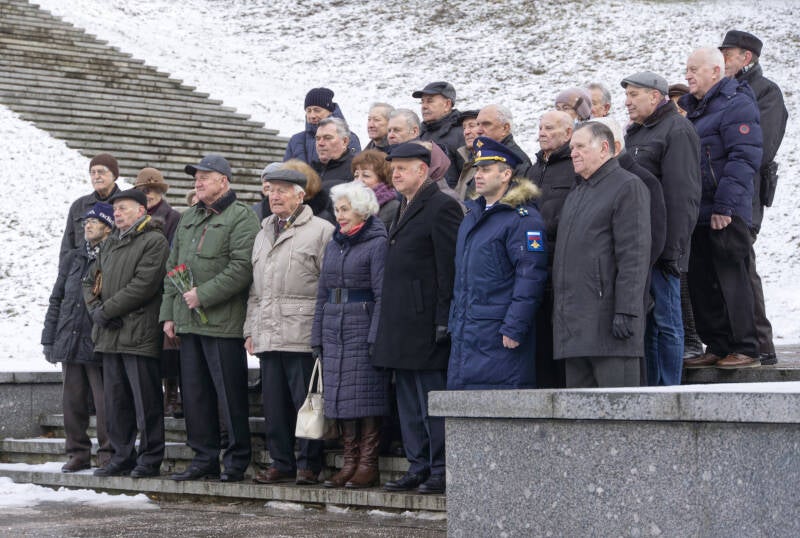
Tovarishchi… A word that carried heavy meaning in the former Soviet republics. The tovarishchi here were probably old enough to remember life in Nikita Khrushchev’s (or even Stalin’s) Soviet Union, and had certainly experienced the collapse of the Socialist empire as a tragedy. The reasons behind their strong emotional attachment to Soviet memory were probably manifold, and impossible to assert without interviewing each individual, but it was undoubtedly strong. Nevertheless, the man who appeared to lead the crowd was clearly younger and cut an odd figure among the pensioners. He was wearing a dark-blue trench coat decorated with Russian military insignia, thick enough to protect from the cold, but not buttoned up all the way to the top in order to reveal the telnyashka he was wearing underneath. His martial bearing was accentuated by an imposing military cap. This was no mere disguise, as the man in question was none other than Colonel Oleg Minzaripovich Davletzyanov, the mysterious military attaché at the Russian embassy in Vilnius. If the elderly individuals present here were the living memory of the Soviet legacy, Davletzyanov served as its official representative. His role consisted of taking a prominent part in every public commemoration related in some way or another to Russia or the Soviet past in Lithuania. Since Putin’s Russia had all but appropriated the Soviet memorial legacy for itself, both were inextricably linked. One may wonder what other tasks Davletzyanov had to perform in his host country…
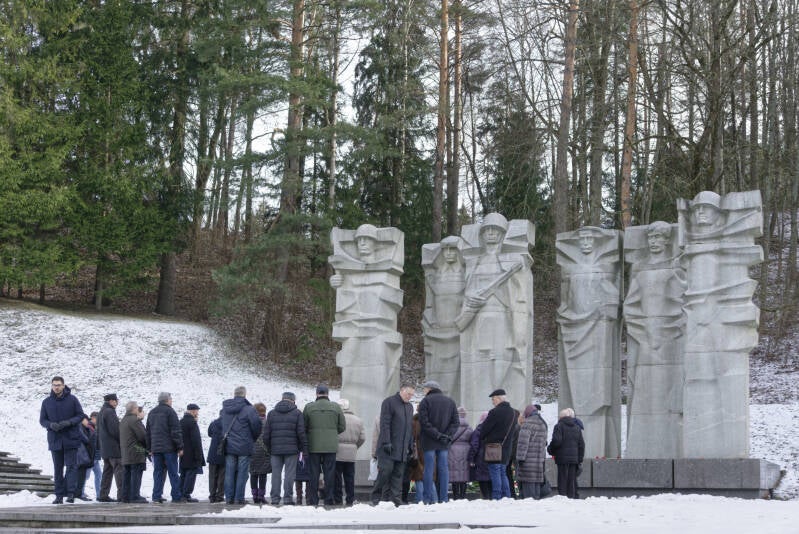
The colonel ordered the crowd to stop and gather for a photograph. They lined up on the slippery steps some distance from the monument, turning their backs to it. Davletzyanov took his place in the front row. It was impossible for the photographer to miss the shot. The participants had positioned themselves right at the spot where the powerful composition of the Soviet memorial was at its most evocative: they stood joyfully in the foreground while the gloomy Red Army granite soldiers could be seen towering above their frail figures in the background. For a few seconds, they froze in place. United in their attachment to the faded glory of a bygone empire, the elders’ wrinkled faces carried a curious array of emotions that the photographer immortalized for posterity. Some attempted to put on feeble smiles that betrayed a form of joyful melancholy; others did not even bother and showed stern faces not entirely unlike those carved on the granite steles behind. They solemnly carried the weight of a ghost, or rather millions of Red Army ghosts with a mythical status who possessed the power to legitimize a state as much as a set of personal beliefs. However, in independent Lithuania, the narrative had been reversed: the liberators of yesteryear were turned into oppressors, the tool of Russian imperialism, an ultimate and ultimately unrepentant enemy of the state. Therefore, such a blatant showcase of support for the “wrong” interpretation of memory could well have signified more than just nostalgia. Perhaps for some of the participants, attending was an act of defiance, a frontline assault against the enemy on its own territory in this Great Patriotic War of symbols, where bulldozers replaced T-34s, and granite soldiers replaced those of flesh and bone.
For a few seconds, they stood motionless before the lens that captured the scene. Time stopped just long enough to create a convincing illusion of success. Their ideology was not discredited anymore. It burst into the open, unchallenged, vindicated by the environment, safely concealed from the outward hostility of Lithuanian society lying outside the gate. “The Red Army was the strongest. We won. We defeated the most heinous foe the world had ever seen. We are not the foe. Our childhoods were not constructed on lies; our adulthoods were not constructed on lies. Russia continues the struggle. Our world still lives on.” How convincing it must have felt at that moment.
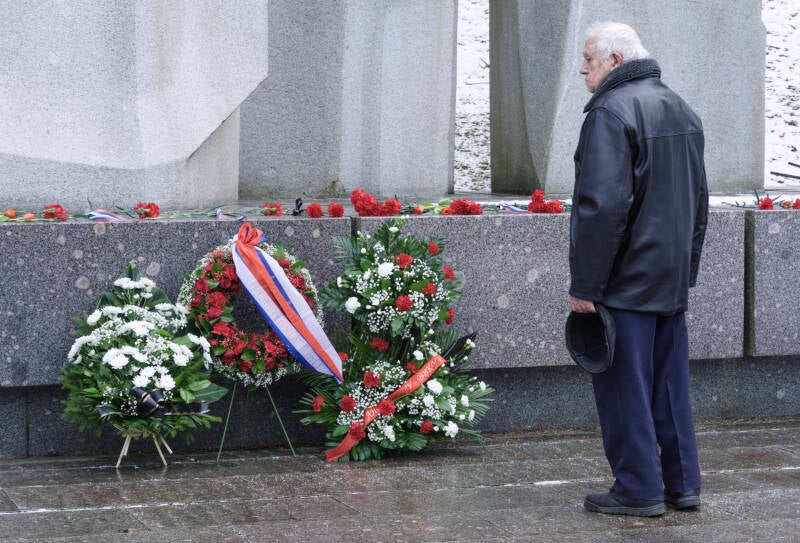
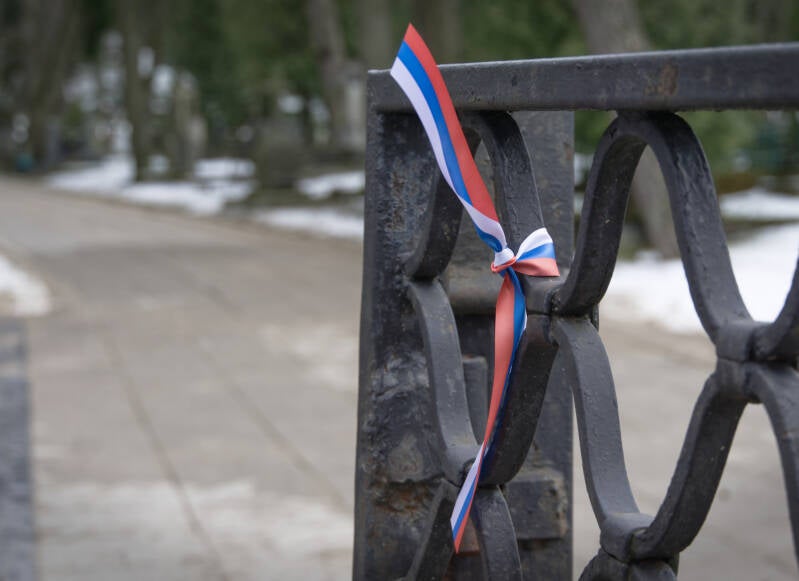
The photographer took the picture that ended up on the website of the Russian embassy in Lithuania. After that, the group remained for a few minutes before walking out toward the exit. Nevertheless, the departure of the crowd did not put an end to the celebration. Some elders, perhaps more eager to experience the solemnity of the event alone or in small groups, waited for the main gathering to disperse before heading discreetly toward the monument. One old man walked all the way to the base of the granite steles and ceremoniously laid a bouquet. He took his hat off as a sign of respect and stood impassively for several minutes in front of a large wreath draped with a Russian ribbon. Suddenly, the man’s gaze lost focus and drifted to the side. His mind seemingly wandered away from the present moment. Was he reflecting on the meaning of his presence, or experiencing the vivid recollection of a distant memory? Alone at the feet of a myth carved in granite, the old man’s intimate tribute was a deeply personal moment. Yet if he refused to share the commemoration with his companion of principles, in the end the man’s path was similar. He also ultimately turned his back on the captivating monument and walked away from the comfort of his memory back to a world that despised his values.
Later, three grey-haired pensioners climbed the steps together to repeat the same ritual. Same determined steps, same display of camaraderie; at least one of them had even prepared for the occasion by dousing himself in what seemed like a full flacon of cheap cologne. The powerful scent that spread through the crisp morning air could have brought a whole regiment of slain soldiers back to life. They did not linger long and walked away together without looking back. After the departure of this last group, the memorial regained its usual tranquility. The chorus of gravelly voices had given way to an eerie silence. Evidence remained of the solemn tribute in the form of flowers and official wreaths laid at the base of the six steles, but the men and women who carried the vacillating flame of Soviet mythology in their hearts were now gone, back to the contemporary world. Whatever sorrow or nostalgia they experienced in Vilnius, their little universe of red glory could survive, albeit uneasily, within a variety of pockets of resistance such as these commemorations. One year later, Colonel Davletzyanov would certainly return to animate the same ceremony at the same spot, where a reduced group of nostalgics would share the same vividly detailed stories under the frozen gaze of the six oversized soldiers.
But this was not to happen.
Unbeknownst to them, Europe was only thirteen hours from war. In thirteen hours, the vainglorious leader of the Kremlin would resurrect the myth of a heroic struggle against the Nazis to justify outright military annexation. For the Sovietophile of Lithuania, these thirteen hours were the very last moment of ideological freedom they would experience in their home country.
Vilnius woke up on the morning of the 24th of February stunned. Although the streets were hauntingly quiet, free from the spine-chilling echo of air-raid sirens and acrid smell of explosions, there was a terrifying realization that the enemy had returned, as ruthless as before. Around the Seimas stood massive concrete barricades, sheltered from the elements to protect them for current and future generations. They were stark reminders that a little more than thirty years before, on this very spot, Lithuanians had to put up a fight against all odds to sever the tentacles of Muscovite imperialism once and for all. Thirty years later, the lethal threat was revived. In Ukraine, first and foremost, where the first civilian and military casualties were already reported in the news, but in Lithuania as well, albeit more indirectly. Without any benefit of hindsight, only the past could provide guidance, and the outcome was hardly reassuring, to say the least. Putin’s military operation, with its Soviet-inspired official terminology and overtly imperial aims, was worryingly similar to the chain of actions that had led to Lithuania’s loss of independence and full integration into Moscow’s orbit in the first place. Ukraine could fall within days, or weeks at best. What would Vladimir Putin do next? Emboldened by success, he could be tempted to cross the ultimate red line and launch a “Special Military Operation” against the Baltic states regardless of their NATO membership.
Yet the quick fall of Ukraine that everybody expected did not happen. Instead, the supposedly swift military operation morphed into a protracted conflict of attrition and Russian troops did not set foot on Lithuanian soil. In fact, no one can predict if they will ever do so. Nevertheless, in the region, the fear of the Russian Bear endured unabated and pushed local governments to act. The easiest and most obvious targets were, of course, the unredeemed Sovietophiles, mostly Russian locals but sometimes natives as well, and their symbols. In Vilnius, nothing conveyed the martial power of the Soviet Union as openly as the Red Army memorial at Antakalnis, since all the other monuments to Soviet power and values had already been dismantled. On the morning of February 23rd, 2022, celebrating the fait d’armes of the Red Army at Antakalnis Cemetery was perceived as a mildly controversial display of nostalgia. Doing so after February 24th, 2022, was tantamount to treason. Therefore, the Red Army Memorial had to go, and it did. However, if the Lithuanians expected the battered Sovietophiles and Russia to observe passively the demolition of their most cherished symbol, they were in for a rude awakening.
The observance of old Soviet national holidays is never a neutral act. Downplaying Russia’s appropriation of Soviet mythology is dangerous precisely because Moscow wields culture and memory as weapons to conquer minds and further its imperialistic agenda. To paraphrase Oleg Orlov: “In the hands of the authorities, history has become a hammer or even an axe.” On February 24th, 2022, the Russians proved their willingness to strike deadly blows with this axe and Lithuania retaliated by striking the centrepiece of Russian historical propaganda in Vilnius. If the full-scale invasion severely crippled the capacity of Moscow’s followers in Europe to counterattack on the cultural frontline, in Lithuania at least, they refused to give in without a fight. The fight over Antakalnis became a protracted battle in which local actors on both sides sought the external assistance of higher institutions to secure the victory they all perceived as quasi-existential.
How did the battle of Antakalnis eventually unfold? This is a story for another time. Nevertheless, on February 23rd, 2023, a few Soviet nostalgics walked back to Antakalnis Cemetery to partake in their annual ritual. A photographer captured the scene and posted the picture online. Gone was the formidable staging of the previous year. Instead, a handful of seniors could be seen posing awkwardly between dilapidated graves in an undistinguished part of the cemetery. No more awe-inspiring Red Army memorial, no more Russian colonel to represent the Motherland. Just a thin crowd comprising a fraction of the previous year’s turnout. The scene looked miserable. It appeared that in Lithuania at least, Russia’s “Special Memory Operation” failed as badly as its military counterpart.
The “official” photograph that ended up on the website of the Russian embassy in Lithuania can be found here (second in the gallery): https://lithuania.mid.ru/ru/embassy/news/o_pamyatnoy_aktsii_v_litve_k_dnyu_zashchitnika_otechestva/
Thank you for reading and viewing this article. Please like and share to show your support.