The Berlin Wall & the Underground Architecture of
West Germany.
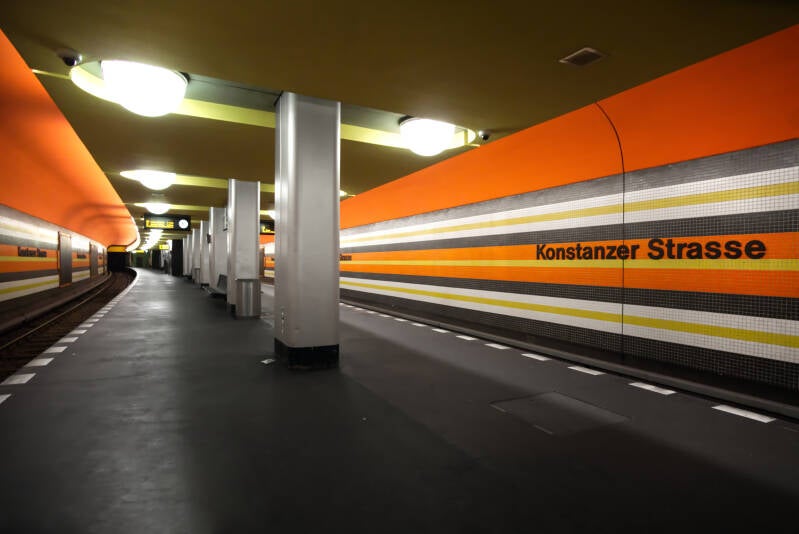
Photo; Konstanzer Straße, 1978
Photography & text by Jean De Sousa.
Berlin Pop Chromatic.
A Journey Through the Forgotten World of Rainer G. Rümmler.
On August 13th, 1961, Berlin was divided into two halves. This abrupt physical separation was deemed necessary to preserve the ideological separation enacted sixteen years earlier. By then, East Berlin acted as the capital of the German (assuredly not very) Democratic Republic, whereas West Berlin existed de jure as a sort of independent city-state surrounded by the GDR. Indeed, contrary to a widely held belief, West Berlin never legally belonged to the Federal Republic of Germany, and although in practice both entities cooperated closely on most matters, at no point during the Cold War did West Berlin fall under the political sovereignty of Bonn. West Berlin’s governance was exercised by local institutions under the watchful eyes of the Allied powers, which held ultimate decision-making power. At first glance, these legalities may not matter much. However, it was precisely the peculiar nature of the West Berlin political system that allowed a simple architect like Rainer G. Rümmler to concentrate immense decision-making power and unleash his creativity over a vast swath of West Berlin.
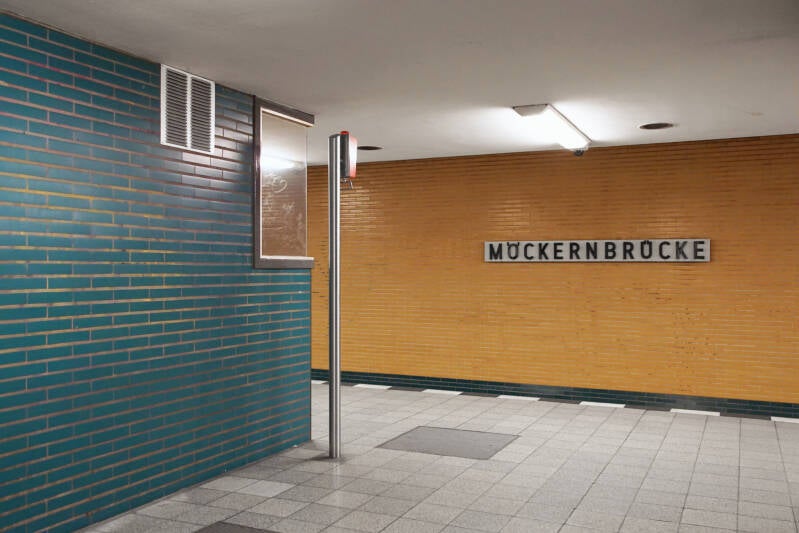
Photo; Möckernbrücke, 1966.
I lived briefly in Berlin in 2016. At that time, my knowledge of the city was clearly lacking and shaped by well-known historical facts as much as by popular culture. So when I moved into my shared flat near Charlottenburg S-Bahn station, right in the heart of former West Berlin, I stepped into a world that was all but unknown to me. Over time, as I wandered around the area to familiarize myself with this novel environment, I gradually uncovered a distinctive Cold War-era legacy that had long been hiding in plain sight. It is no wonder that West Berlin’s modern architectural heritage is so dramatically overlooked. How could it compete with the far more evocative legacy of the GDR scattered a few kilometres away? Long before reunification, East Berlin had already cultivated a mesmerizing aura built as much upon its fascinating political reality as upon its iconic landmarks such as the Fernsehturm, Alexanderplatz, Karl-Marx-Allee, and, of course, the Berlin Wall. In the minds of Westerners, East Berlin became the second capital of socialism, behind only Moscow. Beyond the Wall, however, the development of West Berlin by comparison never garnered much attention, and even to this day, the Cold War period of West Berlin is mostly ignored and reduced to the “capitalist part of Berlin where East Germans wanted to flee.” The cultural impact of East Berlin never fully abated, but that is no excuse to disregard the artistic and built heritage of the other Berlin. These informal walks and U-Bahn trips marked the beginning of my long journey to raise awareness of one aspect in particular of West Berlin’s modern architecture, namely the artistic work of Rainer G. Rümmler. I reached a significant milestone in 2023 when, after two years of gruelling work, I released my book, “Berlin Pop Chromatic: The Underground Architecture of Rainer G. Rümmler,” from which I derive most of the content of this piece. All the pictures featured in this article were taken in 2021. Although nothing significant has happened to Rümmler’s stations in recent years, it is important to note that some elements shown here and there may look different nowadays.
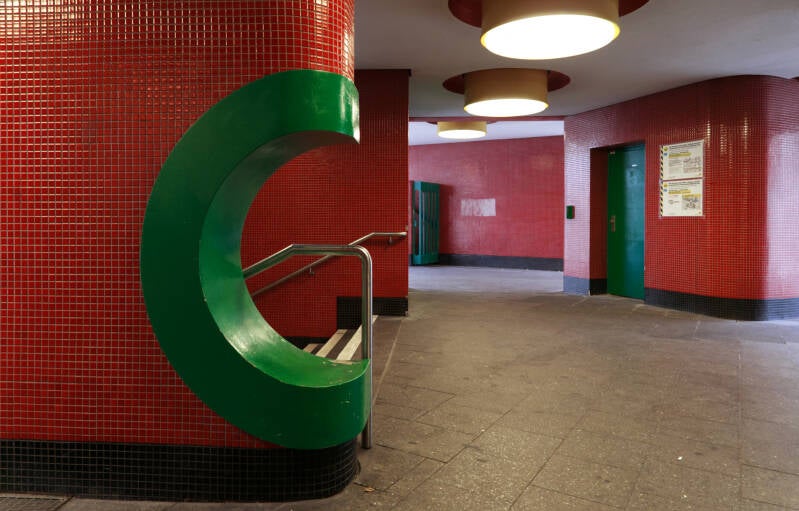
Photo; Fehrbelliner Platz.
Rainer G. Rümmler was an architect who achieved the dream of every architect: being given complete control over his work. Born in 1929 in Leipzig, the man grew up in the bucolic district of Spandau, a small town recently attached to the German capital. After the war, Rümmler studied architecture at a time when the profession had hardly ever been in such high demand, considering the amount of reconstruction needed to rebuild the country. The young Rümmler graduated and immediately undertook a meteoric rise that propelled him to the top of his profession at a very early age. In 1964, aged only 35, Rainer G. Rümmler was appointed construction director at the West Berlin Senate Building Administration. All things considered, the position conferred quasi-dictatorial architectural powers upon the young man, who would remain in charge until 1994. During those thirty years, Rümmler would leave his highly distinctive imprint on the western side of Berlin.
The architect designed more than one hundred buildings and fifty-eight U-Bahn stations. These figures are even more impressive when we consider that only fifty-nine U-Bahn stations opened in West Berlin between 1964 and 1994. That’s right. On only one occasion in thirty years did Rümmler relent and yield his absolute power. Rümmler’s underground heritage is particularly significant because it has always been a product of its time. Indeed, Rümmler’s stations are not only fantastic works of art, they are literal time capsules preserving the spirit of Cold War West Berlin. Yet almost as soon as Rümmler retired, his unique legacy came under severe threat. A significant number of highly unique stations designed by Rümmler were demolished under the guise of “modernization,” with the peak of these losses reached in 2016.
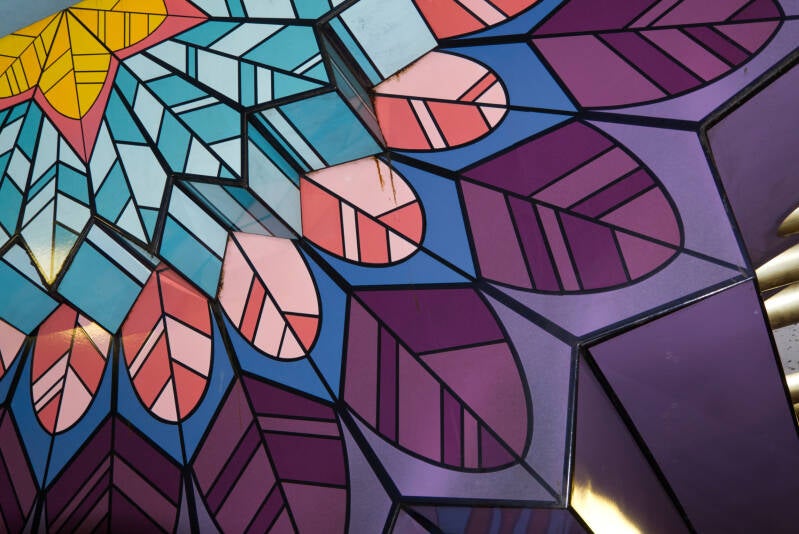
Photo; Paulsternstraße.
Rümmler’s first stations, designed from 1962 to 1971, fit squarely into the International Modernist style so popular at the time. They are sleek, harmonious, sometimes downright minimalist, but rarely outstanding. A few of them, especially on the U7, have survived relatively unscathed to this day and offer a fascinating window into the era when West Berlin was striving to forge a new, uncompromisingly modern identity in order to break away from the troubled recent past. Kleistpark is a good example of powerful simplicity, but Bayerischer Platz is much more captivating. Bayerischer Platz is an old U Bahn station opened in 1910 on what is today the U4. In 1971, with the extension of the U7, Bayerischer Platz became an interchange station. Rümmler masterfully replicated the artistic concept of the 1910 station, with a blue and white color scheme intended to evoke Bavaria, but translated it into the visual language of the early 1970s. The result is stunning. One stylistic approach, interpreted by two architects from dramatically different eras. At Bayerischer Platz, Berlin history collides. Crucially, Rümmler’s vision at Bayerischer Platz reveals an undeniable Pop influence that would become his trademark.
Fehrbelliner Platz station opened the same year and, similar to Bayerischer Platz, is an interchange station placing side by side two stations built sixty years apart. Unlike at Bayerischer Platz, though, Rümmler wholly ignored the original station and designed an outstanding monument to 1970s Pop architecture. For the first time, but not the last, Rümmler faced heavy criticism for his bold approach. Local newspapers strongly criticized the station pavilion Rümmler erected right in the middle of Fehrbelliner Platz, citing its discordant presence within the local cityscape. They were not wrong. Rümmler’s purple coated, oddly shaped building contrasts with extreme abruptness against the gloomy, menacing Nazi era behemoths that surround the square. Regardless of personal taste, the symbolism is powerful: Speer’s Berlin pitted against Rümmler’s Berlin. Two radically opposing visions that cannot blend harmoniously into each other. But that is precisely the point. Nowadays, the funky entrance to Fehrbelliner Platz station still stands proudly, just like Otto Firle’s architectural ensemble. The architectural coexistence is clearly uneasy, but it has endured. In a city so quick to erase its Modernist heritage, this is highly unusual.
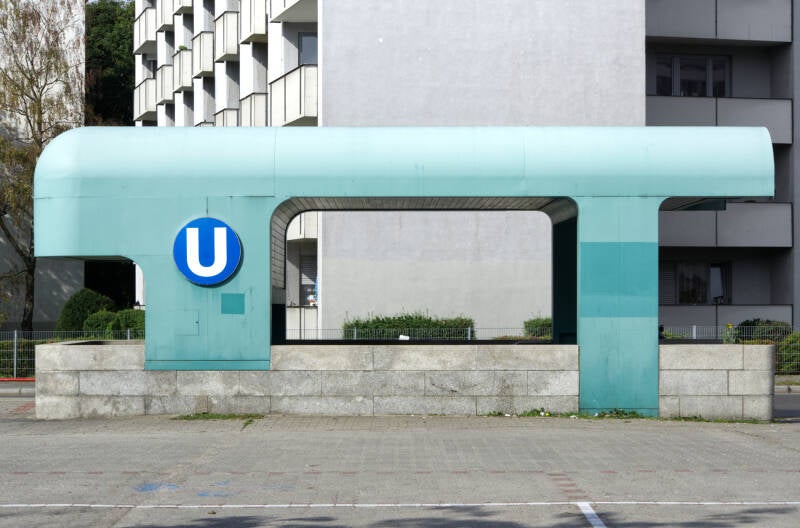
Photo; Siemensdamm, 1980. Creativity extended at street level.
Underground, Rümmler’s Fehrbelliner Platz is similarly uncompromising. The design screams 1971 and, still to this day, propels commuters back into a world of color and optimism radically opposed to the strong authoritarian undertones of the square above. Fehrbelliner Platz on the U7 was the final station of the 1971 extension, but it foreshadowed the chromatic explosion that was about to follow.
Only three years later, the U7 was extended once more. If Rümmler began as a Modernist architect who experimented with novelties here and there, by 1978 his transition to Pop architecture was complete. From that point onward, every station became a phenomenal piece of Gesamtkunstwerk in which art and architecture were all but inseparable. Interestingly, despite the radical uniqueness of his creations, Rümmler followed a rather simple and consistent formula, albeit one that produced widely different results. He would settle on a specific theme or feature, often related to the district served by the station, and derive from it a fantastic underground world unlike anything seen before. The stations follow one another, yet look nothing alike. If Fehrbelliner Platz was bold for 1971, Konstanzer Straße, which follows it on the U7, is a literal chromatic explosion, a dazzling tour de force whose captivating design is as radical as it is coherent. Rümmler relied on the clichéd concept of “speed” to deliver what is arguably one of the most striking examples of 1970s Pop design ever created and preserved in a public infrastructure.
Gradually, Rümmler refined his style and veered in several directions with more or less popular success. In the 1978 extension, the architect started to experiment with geometric abstraction in order to produce even more unique, and sometimes utterly bizarre, compositions, notably at Wilmersdorfer Straße. Perhaps too unique, because a vocal minority of West Berliners, clearly unimpressed by Rümmler’s U Bahn stations, started to mount a public attack against the architect. Besides, how could one architect wield such dictatorial power? Was the West Berlin Senate emulating the undemocratic practices of its Eastern neighbour? For the second time in his career, Rümmler faced significant resistance from the public, but while the previous attack targeted one of his buildings in particular, this time it was his entire position that was threatened. Yet in the end, nothing came of it. Rainer G. Rümmler maintained his position and kept designing stations on an industrial scale. Oblivious to criticism, he perfected geometric abstraction through the years until he produced his masterpiece, Paulsternstraße, in 1984, which concluded this period. Paulsternstraße is a wholly uninteresting street that has little to offer in terms of symbolism. It was precisely this lack of defining features that pushed the architect to think further outside the box than anywhere else. Consequently, he conceived an underground world recalling the pastoral nature of the area before the twentieth century. The result is nothing short of stunning. Paulsternstraße is a masterpiece of imaginative design, transporting the traveller into a dreamlike state of bucolic bliss beneath the clear sky of a summer night.
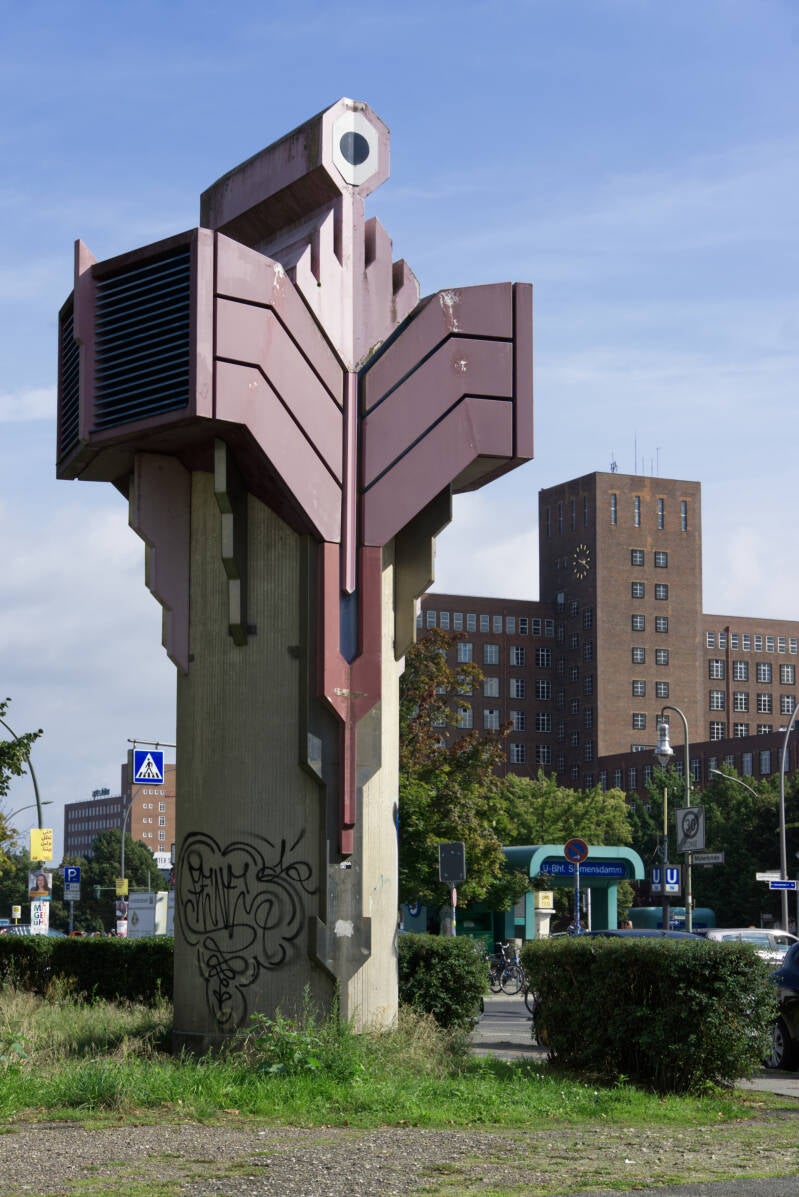
Photo; ...as above.
Rümmler’s commitment to creating a unique underground world never flinched, but his style evolved gradually throughout the years. When the U7 reached Spandau in October 1984, the architect had clearly embraced Postmodernism. However, more than a simple artistic evolution, the final extension offers a fascinating window into the West German mindset of the time, of which West Berlin was a de facto extension. In the 1960s, International Modernism was favoured in West Germany precisely because its moral restraint suited a society born from the ashes of the Third Reich. With the monumental Rathaus Spandau station, for instance, the terminus of the line, Rümmler did not revert to the highly controversial pre-war architectural canon, but instead demonstrated that the moral drive for restraint had definitively lost its substance and that Postmodernism could rehabilitate certain formerly tainted elements without necessarily resurrecting their political significance in the process. Designing a station like Rathaus Spandau would have been impossible two decades earlier. In a way, Rathaus Spandau foreshadowed the rebirth of a new, unified, and independent Germany ready to confront its difficult heritage.
I have principally focused on the U7 because the line offers the most coherent and compelling, though sadly not the best preserved, ensemble of Rümmler’s work. But Rümmler worked on other lines as well, notably the U8, on which he designed his final stations. The northern section of the U8 is a throwback to the late 1980s, beginning with a farewell gesture to nonfigurative art at Franz Neumann Platz, followed by more realistic, though no less creative, Postmodern work. It is worth stopping briefly at Residenzstraße. Residenzstraße’s surreal pseudo bourgeois style can imaginatively be described as “Pop Stalinism.” The station’s opening in 1987 coincided with the 750th anniversary of Berlin, which was extensively celebrated on both sides of the Wall. For West Berliners, however, celebrating Berlin’s history proved particularly awkward since the true historical core of the city lay squarely on the eastern side of the divide. In the station, Rümmler included numerous historical drawings of Berlin, almost all of them depicting landmarks inaccessible to West Berliners. Nowadays, these references to history convey no particular meaning. But for a passenger riding the U Bahn in 1987, they endorsed a vision of Berlin as one city long before unification was even envisioned.
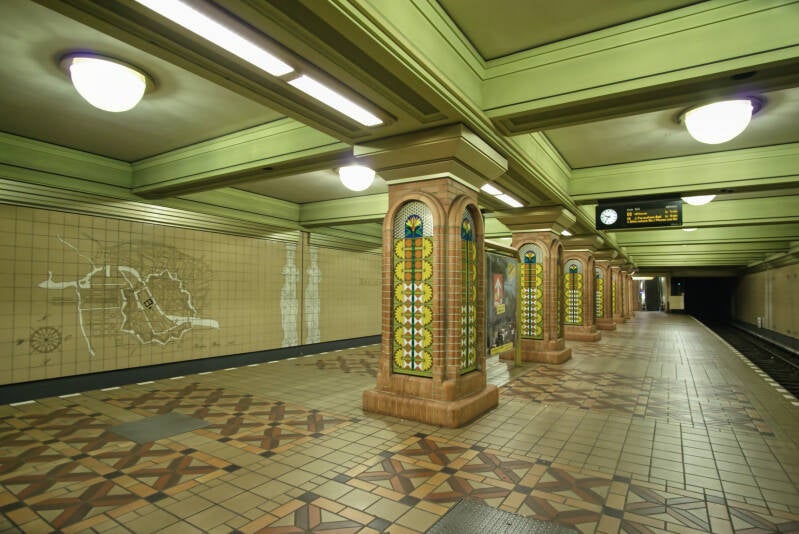
Photo; Residenzstraße, 1987.
The 1994 extension of the U8 appears as an appropriate farewell gesture from an aging architect. If Lindauer Allee retains the spirited and colorful approach to design characteristic of his earlier works, the final stations, especially Karl Bonhoeffer Nervenklinik and Rathaus Reinickendorf, are cosy and evoke the faded warmth of an old brick building more than that of a subway station. By 1994, West Berlin no longer existed. Reunification had occurred, and by then the spirit of the Cold War had lost relevance. Although they may appear rather outdated, especially underground, Rümmler’s final stations are in fact not only highly contemporary but also remarkably relevant to our own time. They are the product of an era in which interest in historical architecture became fashionable again without excluding contemporary creative solutions. This trend, strongly linked to Postmodernism, has fared poorly in reunified Berlin, where unbridled nostalgia led to tragic architectural losses and culminated in the dramatic destruction of the Palast der Republik, followed by its replacement with the appalling Humboldt Forum in 2020.
As we have seen throughout this piece, Rainer G. Rümmler left an immense legacy to Berliners. Nevertheless, Rümmler’s excessive originality was perhaps too difficult to grasp and, ironically, too much a product of its time to be perceived as truly worth preserving. It did not help that most U Bahn stations from the 1970s are infested with asbestos contained in the Eternit decorative panels that Rümmler used extensively. When technical defects meet popular disinterest, architecture usually succumbs to time before it can be protected. This is almost what happened to Rümmler’s heritage, but after the Berlin transport company destroyed about a third of the architect’s unique stations over the course of twenty years, and demolished the original benches and signage in all of them, a group of local enthusiasts teamed up and formed a committee eager to stop the disaster. It is supremely ironic that the lack of a clear political ideology in Rümmler’s work certainly facilitated the destruction of his heritage. East German art and architecture are constantly, and sometimes excessively, associated with the repudiated socialist ideology, to the point that any objects of value created under that regime can attract attention precisely because of their historical significance. Sometimes, however, the opposite outcome occurs, and destruction is motivated by the association with the DDR. More often, historical distance helps contextualize controversial artefacts. But Rainer G. Rümmler is associated with a regime that left little imprint on contemporary culture precisely because modern Germany is simply a continuation of the old FRG. As a result, his work has all too often been perceived as merely outdated rather than historical. Fortunately, in recent years the committee has scored decisive victories and, most recently, almost all of Rümmler’s remaining stations received protected landmark status. This will not bring back the lost works, but the victory is nonetheless more than welcome.
Ten years ago, I was drawn to the fantastic underground world of West Berlin’s architect in chief at a time when the fate of his heritage lay in the hands of people who had both the will and the power to erase it. Fortunately, a group of highly motivated enthusiasts fought back and succeeded in safeguarding this entire chapter of West Berlin’s history. So the next time you travel to Berlin, do not forget to head west of the former divide. There, beneath the ground, what is left of the unique universe of Rainer G. Rümmler awaits you.
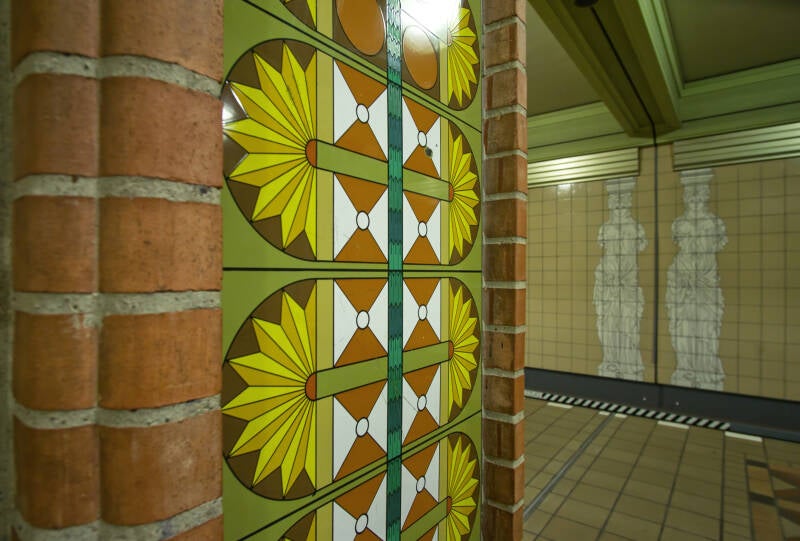
Photo; also Residenzstraße.
Thank you for visiting this article and photo essay. Please like and share to show your support.