China, the traditional home of the tea shop.
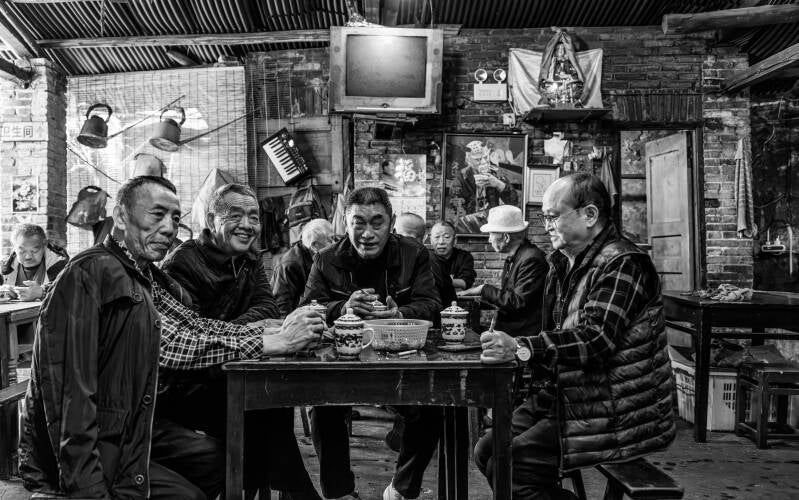
Regulars gather around a table at Chongqing’s Transport Teahouse.
BETWEEN ERAS.
Tradition and Change in China’s Teahouses
Photographs & text by Omar Shamma.
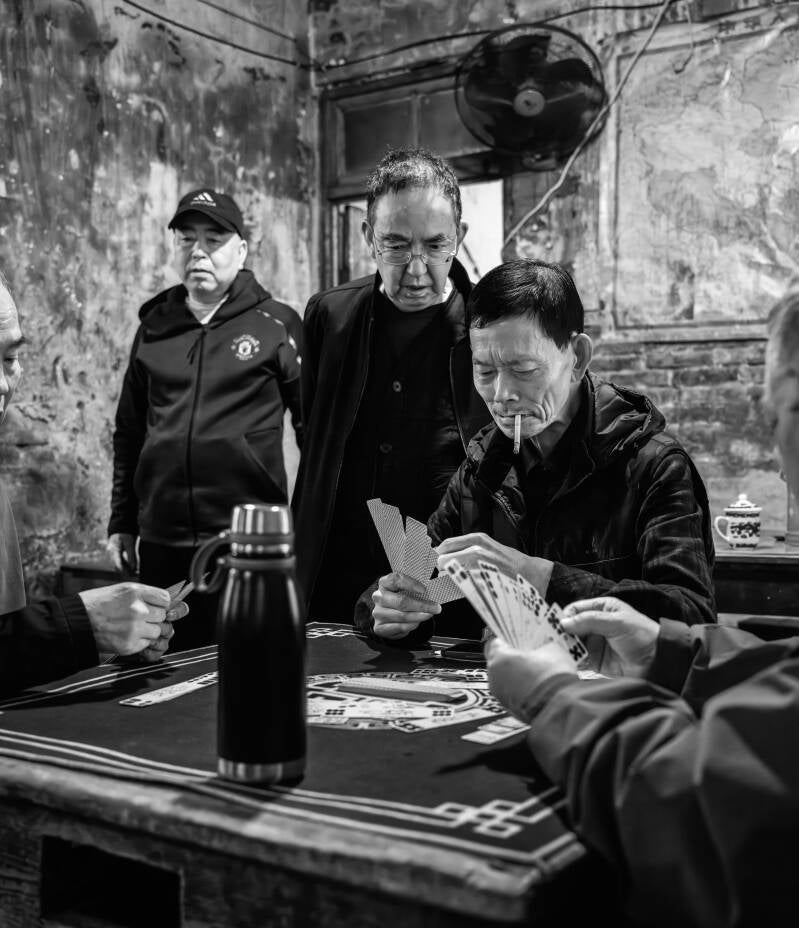
A card game draws players and onlookers together at Chongqing’s Transport Teahouse.
Across Chengdu, Pengzhen and Chongqing, traditional teahouses continue to occupy a distinctive place in everyday social life. They are places to drink tea, certainly, but also to meet, talk, play games, exchange news, or simply spend time in the company of others.
At the Guanyinge Old Teahouse in Pengzhen, this tradition stretches back over a century. The surroundings are rustic and functional: worn bamboo chairs and tables, old thermos flasks, battered metal kettles and walls carrying the accumulated traces of decades of use.
Regular customers arrive early and may remain for hours. There is little ceremony. Tea is drunk as conversations unfold and games are played around tables worn by decades of use.
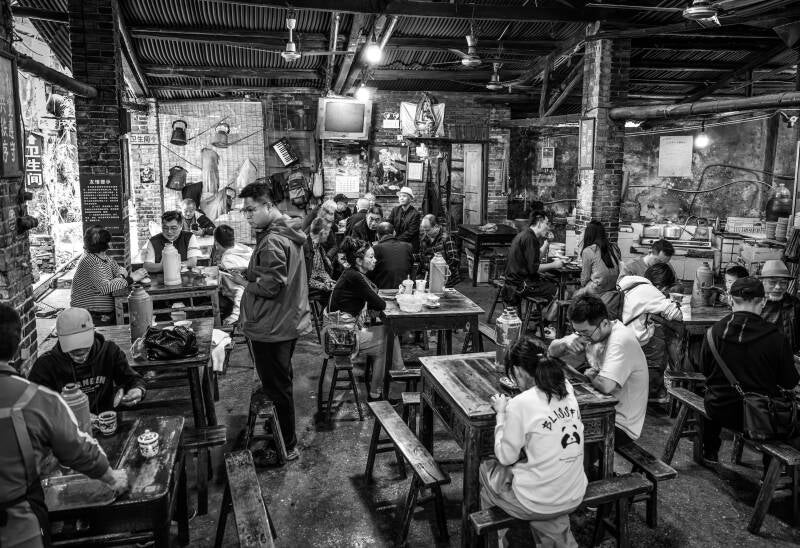
Older and younger customers share the traditional surroundings of Chongqing’s Transport Teahouse.
In fact, games are an important part of this social life. Cards can occupy a table for hours, but the game rarely belongs only to those playing it. Others gather around, watch, comment and join the conversation.
The game provides the focus. The gathering around it is equally important.
Generations.
Yet these are not places inhabited only by an ageing generation.
As the morning progresses, the composition of the teahouse changes. Younger customers begin to appear alongside the older regulars. They occupy the same bamboo chairs and drink from the same covered tea bowls, while smartphones sit beside them on the tables.
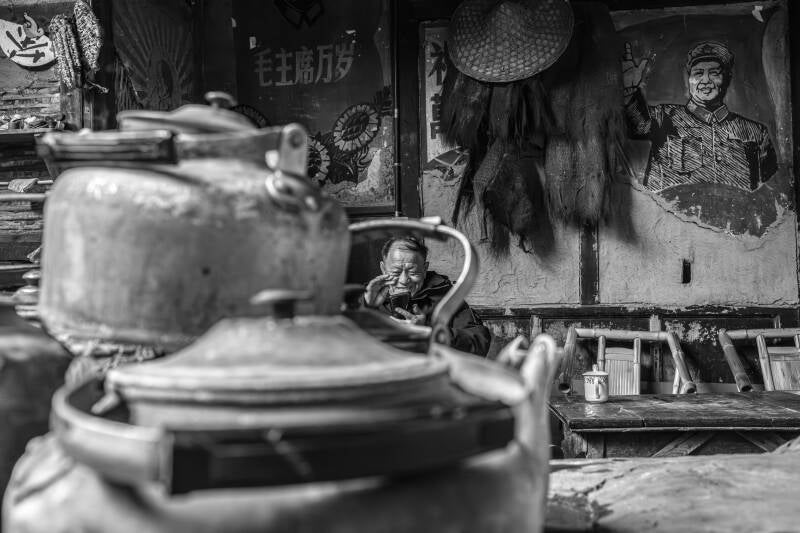
An older customer smiles at his smartphone, framed by the battered kettles of the Guanyinge Old Teahouse in Pengzhen. A fading image of Chairman Mao remains on the wall behind him.
Sometimes the relationship between different eras can be contained within a single scene. An older man sits smiling at his smartphone behind a jumble of enormous battered kettles. On the wall behind him, Chairman Mao looks down from a fading mural.
Nearby, a younger man reclines in a bamboo chair reading, his phone lying on the table beside his tea. Neither appears out of place.
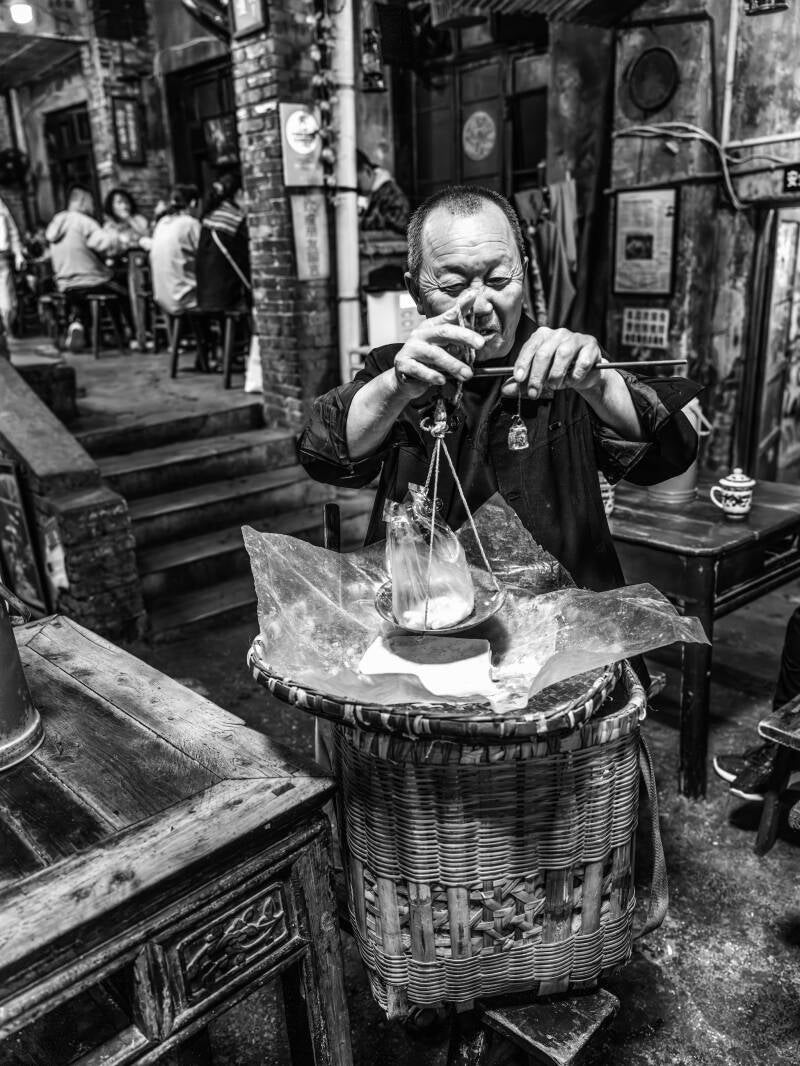
The sweet seller weighs a portion using a traditional balance at Chongqing’s Transport Teahouse.
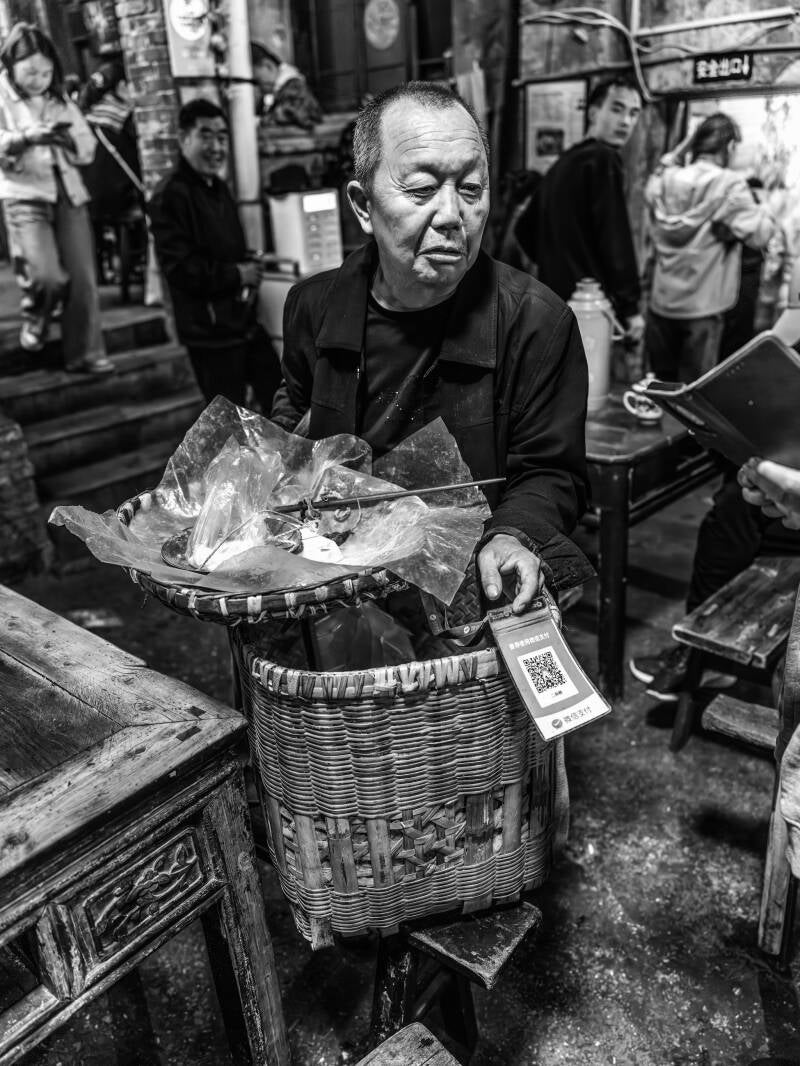
The seller presents a QR code to be scanned by the customer for payment at Chongqing’s Transport Teahouse.
Adaptation.
Perhaps the clearest expression of this coexistence came from a traditional sweet seller moving among the customers at Chongqing’s Transport Teahouse.
He announced his presence with the distinctive, almost bell-like sound of hammer striking chisel. The sound attracted attention; the same tools were then used to cut portions of the sweet. Each portion was weighed using a traditional balance.
Then came the payment. The seller produced a QR code to be scanned by the customer for payment.
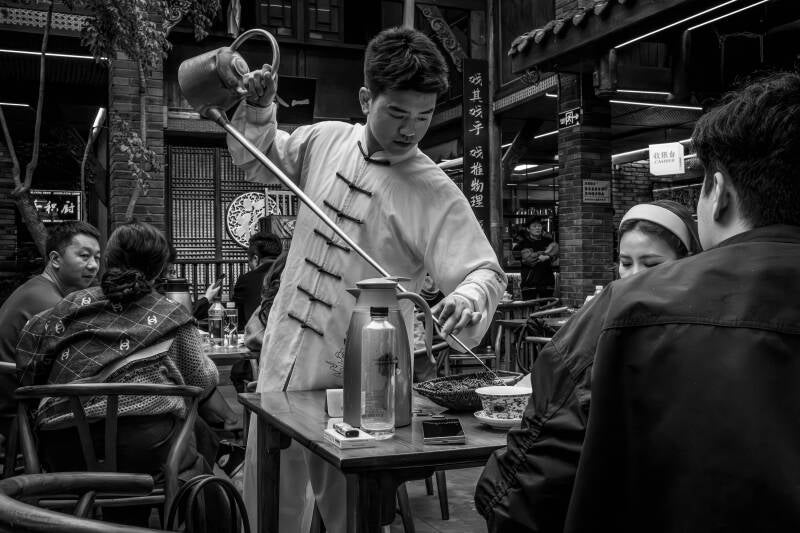
A young performer demonstrates the traditional long-spout technique of pouring tea at a courtyard teahouse in Chengdu’s Kuanzhai Alley.
Tradition Reimagined.
Elsewhere, continuity takes a different form.
In the restored historic surroundings of Chengdu’s Kuanzhai Alley, traditional culture is consciously presented to a contemporary audience. Courtyard teahouses offer storytelling, music and Sichuan Opera alongside tea.
Young performers demonstrate the dramatic technique of pouring tea from long-spouted kettles, transforming the simple act of adding hot water into a performance.
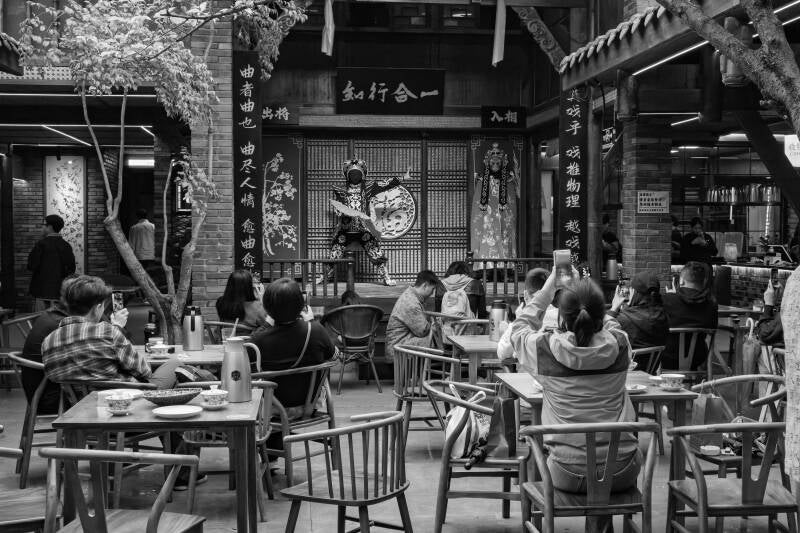
Traditional theatre is performed before a contemporary audience at a teahouse in Chengdu’s Kuanzhai Alley.
Traditional theatre and Sichuan Opera are performed before audiences in which smartphones and digital cameras are frequently raised to record the spectacle.
It would be easy to dismiss this simply as tourism or nostalgia. That was not how it appeared to me. What interested me was the apparent curiosity among younger Chinese visitors and their willingness to experience traditions that may no longer form part of their everyday lives.
At Pengzhen and Chongqing, tradition survives largely because people continue to live it. At Kuanzhai Alley, aspects of that tradition are consciously rediscovered, performed and experienced anew. They are different forms of continuity.
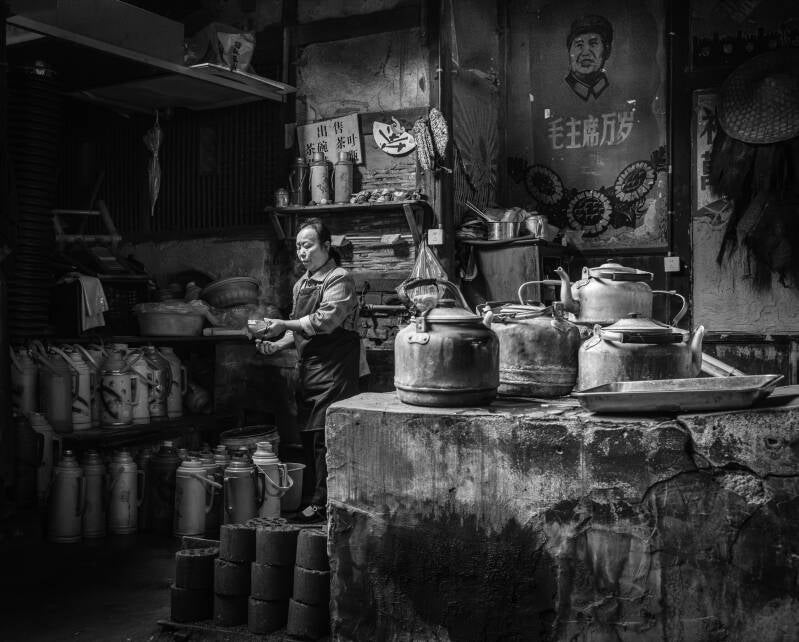
A worker prepares hot water among kettles and insulated flasks in the kitchen of the Guanyinge Old Teahouse in Pengzhen.
Keeping the Tea Flowing.
Behind the apparent leisure of the teahouse is constant work.
At Pengzhen, much of that work takes place amid equipment that appears to have changed remarkably little. In the old kitchen, large battered kettles sit over coal-fired burners. Staff work among rows of insulated flasks while heat and steam fill the confined space.
Boiling water is transferred from the kettles into insulated flasks that are carried out to the tables. Staff deliver the initial bowls of tea together with hot water; after that, customers largely look after themselves, topping up their own bowls as they drink.
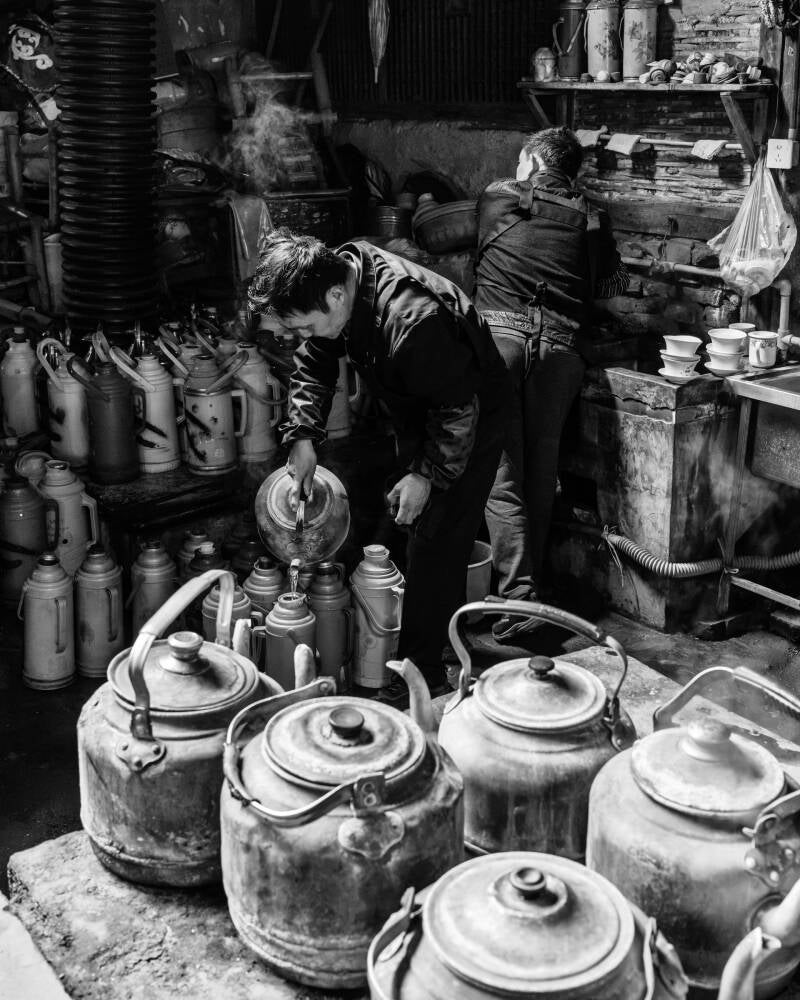
Boiling water is transferred from battered kettles into insulated flasks at the Guanyinge Old Teahouse in Pengzhen before being carried to customers.
The equipment may belong to another era, but the system remains thoroughly practical. Kettles are filled, heated, emptied and filled again. As long as customers remain in the teahouse, the water must keep flowing.
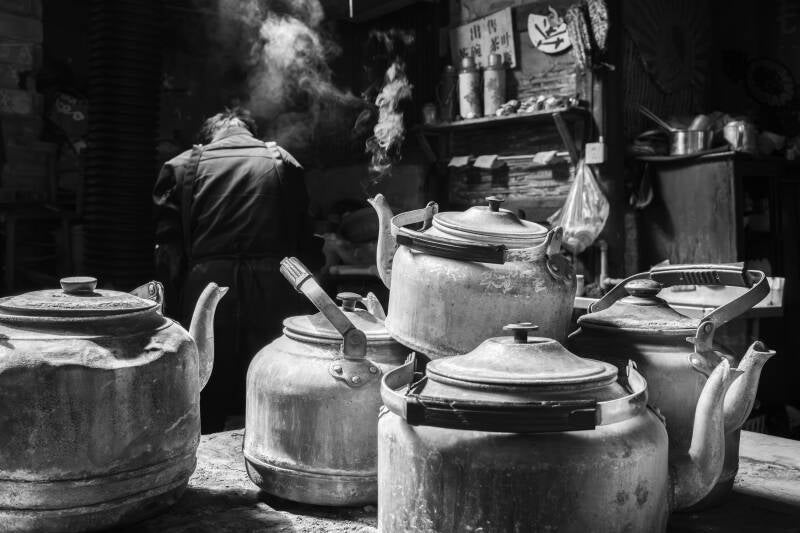
Steam rises from kettles in the kitchen of the Guanyinge Old Teahouse in Pengzhen as hot water is prepared throughout the day.
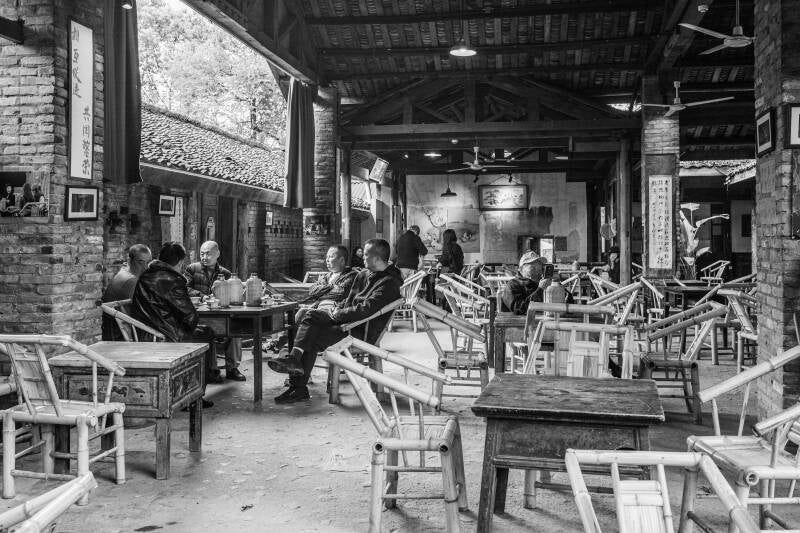
Customers relax among rows of bamboo chairs at another traditional teahouse in Pengzhen.
What Endures.
Beyond the activity of the kitchen, the rhythm of the teahouse continues.
People sit around tables. They drink tea. They talk. Some stay for hours. Others come and go. Around them, rows of bamboo chairs wait for the next customers.
What I encountered in these teahouses seemed to reflect something broader that I observed in contemporary China. Modernisation does not necessarily require tradition to be discarded. Instead, the old and the new frequently coexist, with technology incorporated into established practices rather than simply replacing them.
The teahouse offers a small but revealing example. Bamboo chairs remain. Water is still boiled in battered kettles. A sweet seller still uses a hammer, chisel and balance. Yet payment is made by QR code, smartphones sit beside bowls of tea, and traditional performances are recorded digitally.
The people change. The technology changes. The ways in which traditions are experienced can change. Yet the fundamental purpose of the teahouse seems remarkably persistent: a place to meet, talk, play, watch, laugh, or simply sit for a while in the company of others.
The traditional teahouse appears to be a constant around which modernity is accommodated.
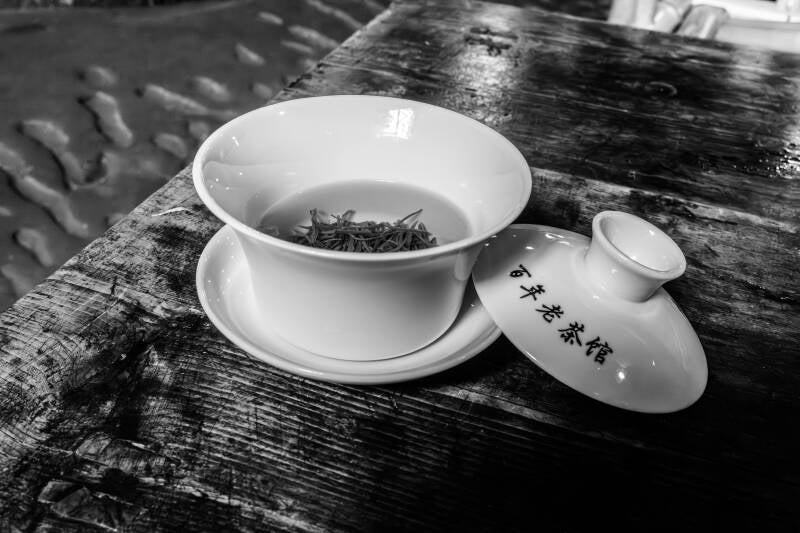
A gaiwan of green tea rests on a worn wooden table at the Guanyinge Old Teahouse in Pengzhen.
We appreciate you taking the time to read and view this article. Please like and share to show your support for this work, it helps us immensely.
To see more photo essay's by Omar Shamma follow the link.