After the War in former Yugoslavia.
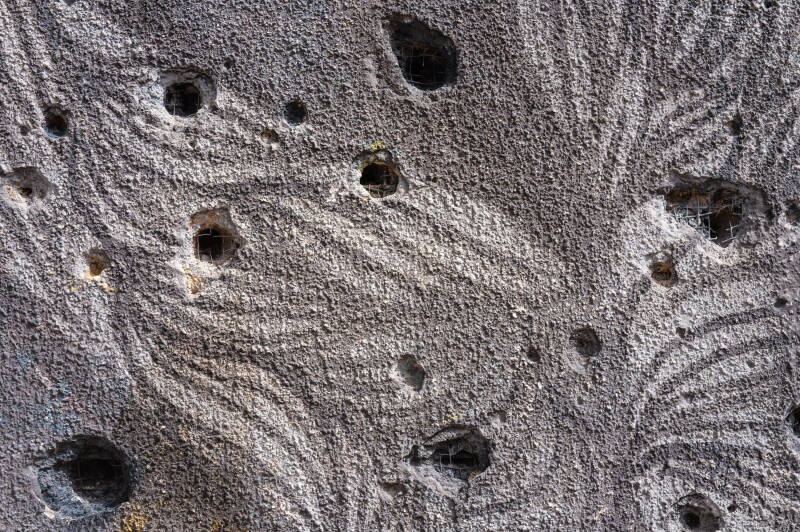
Graffiti on a bullet-ridden wall of an abandoned building,
I Remember When I was a Window.
Photographs & text by Sajad Ahmad.
The city feels torn. The old town seems to be living with wounds all too fresh. A seemingly uncomfortable air of compromise, where it seems wounds are just too fresh to forget. Yet tourists walking the cobblestone paths come in droves. Photographing the Stari Most, Mostar’s old bridge. Ignoring what is likely on the surface, considered too uncomfortable to talk about, where the taste of grilled food is second to none, the rebuilding of the bridge has become no more than a passing topic; people pull out phones for a selfie at a place that is still a sight of painful memory for many. Words like aggression, war, and shooting are talked about. Rarely is there talk about the reasons leading to it. Direct blame is virtually never spoken of. The easiest option is to just carry on. Perhaps the fear of causing upset is all too great. Or perhaps, it's just easier to forget. But how could one, when it stares you in the face? Of walls riddled with bullet holes, or graffiti all too painful to reflect upon. Of millions displaced, or hundreds of thousands killed. The research and documentation centre in Sarajevo (RDC) individually documented close to 100,000 named victims, many more still unconfirmed. Names recorded in the Bosnian book of the dead. While the war crimes are plenty to recount here, the dark shadows of those horrors are still present today.
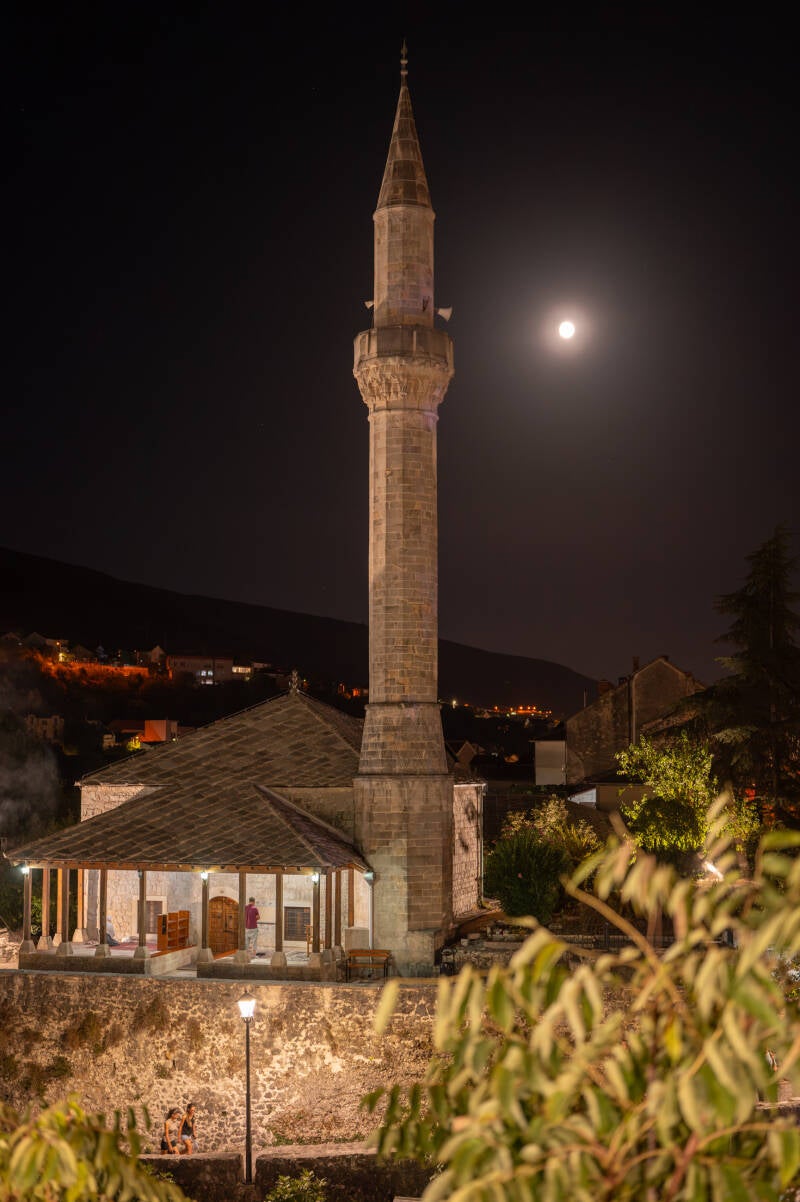
Night Prayers, Mostar 2026
Walking along the bridge, I can’t help but imagine the hardships families went through here. Standing on the cobblestone path, Najad, an owner of a business, recalls the questions he often gets asked from tourists: “They say, 'How do you manage fasting in Ramadan?” with a smile on his face he beams as he tells me the next, a typical question that is all too common: “They ask, 'You can’t even drink water?,‘ he says, “I answer, it’s easy, with a smile, for three years, we didn’t have any water.”
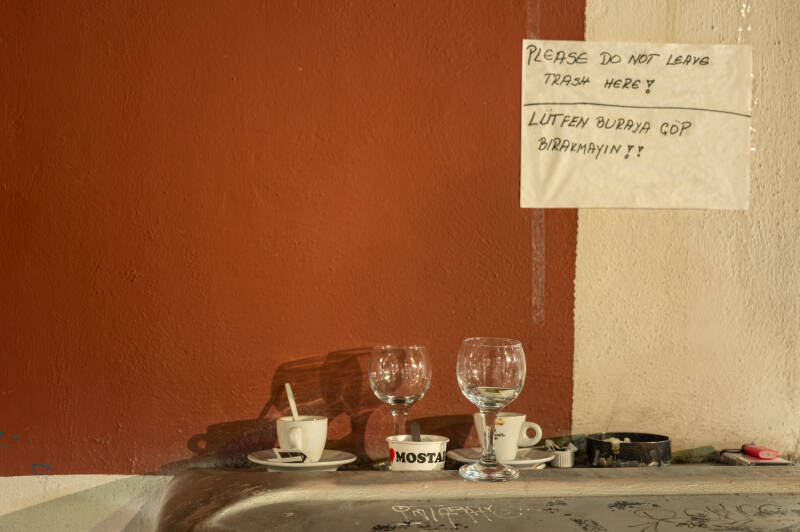
Do not leave trash, Mostar.
In the 1990s, when TV screens were square and often came with table stands, when antennas on top would allude to the hope of making the picture more viewable, when a slight thud to the side would potentially clear the TV snow, the static often making viewing difficult, this glass window mirrored to the world the horrors that were unfolding. Images that have become far too ingrained in our minds came from that period. Anyone of sentient age would remember how we watched almost on a daily basis what was happening to this region of Europe. Perhaps the memories of the Second World War were still fresh in the minds of our elders; for me, they were stories often narrated to me by my father. How armies had swept across countries, causing utter devastation. How the war triggered and continued for years, taking the lives of so many. It’s strange then, how humanity has so quickly forgotten its own doing. Driving across Bosnia, the signs are all too fresh. Crossing the border from Croatia, I had started to notice enormous religious symbolism lining the roads. It seemed more of a claim on the territory than of religious reverence. For isn’t devotion and piety practised more inwardly? Perhaps I take what I see too literally. Perhaps it’s a fault in my thoughts that I need to revisit.
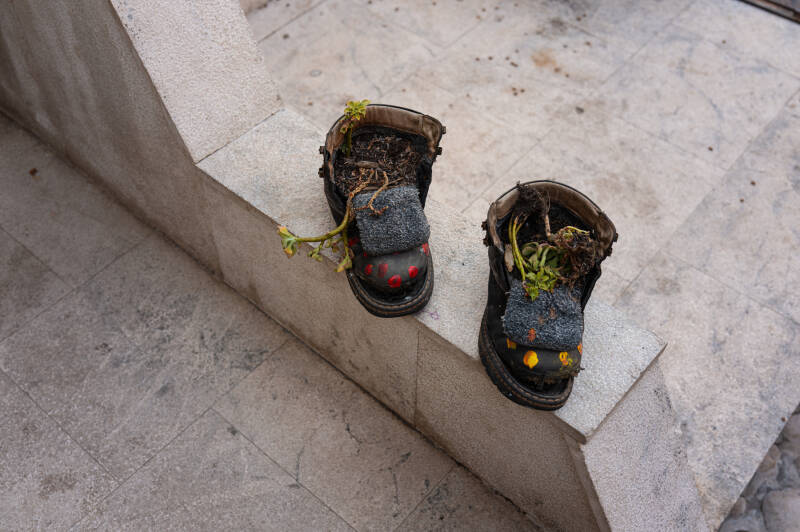
War boots, Bosnia.
In Mostar, the news of the dead has already travelled. Along the Neretva River, it has done little to heal the hurt and misery left behind. Speaking with Najad’s wife, Susan. I said, “You know General Mladić died?” “Of course”, says Susan. “AlhamduliLah” (Praise be to God), says Najad. “But what good does that bring us?” “True”, I say. While Mladić died behind bars in the Western world, I cannot help but imagine the comforts he would have received in a democratic prison. Where food would have been provided to his needs. Where water would have been fresh and plenty. Where medical care would have been first-rate, more than what can be said for so many in a country that he tried to eradicate.
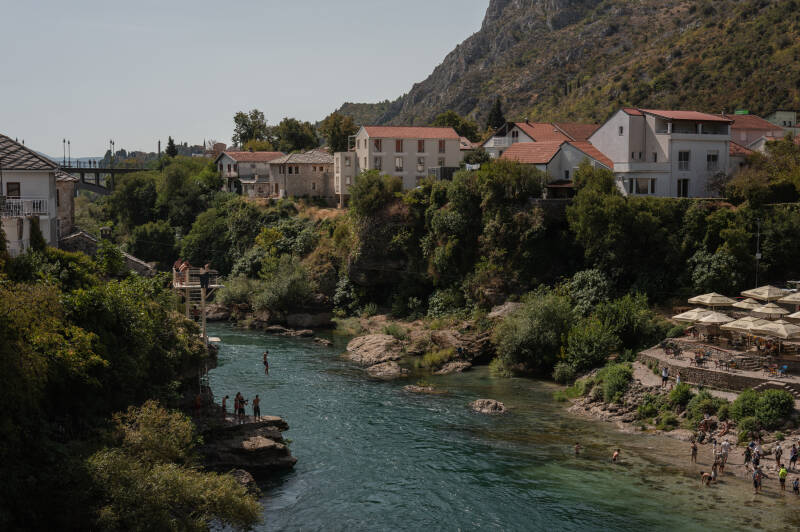
Old Town Mostar, photographed, August 2026.
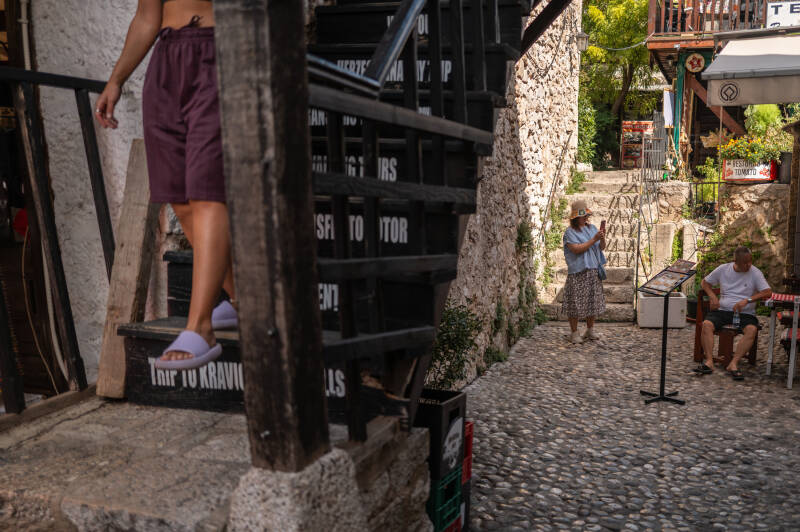
Tourist accommodation, Old Town, Mostar.
No misconceptions: we still linger in confusion over the definitions of genocide, while one happens right in front of our eyes. Of what is and isn’t ethnic cleansing. The world fails time and again. In Arabic, the word for mankind is “Insan”, literally translating to “the one who forgets”; the title given to man seems so appropriate. Ask any Bosniak, and they will tell you the tales of living memory. Yet, man just forgets.
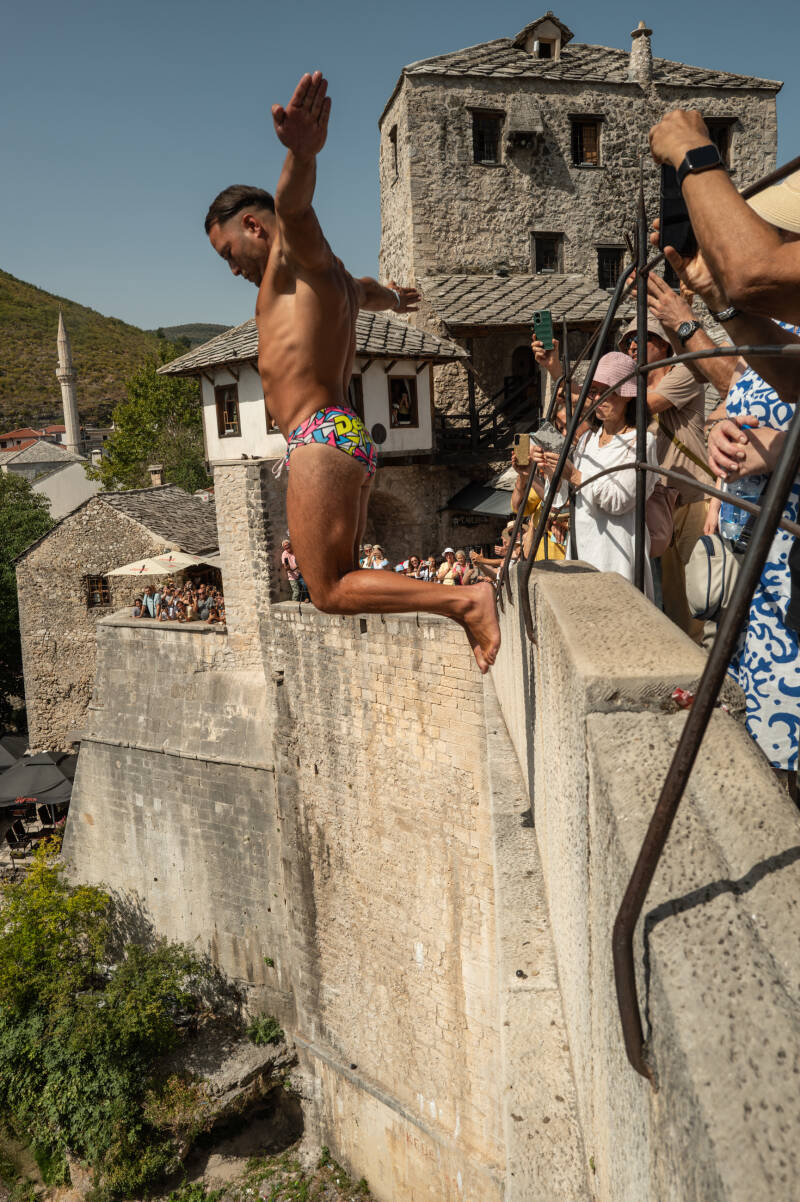
A diver jumps from Mostar bridge.
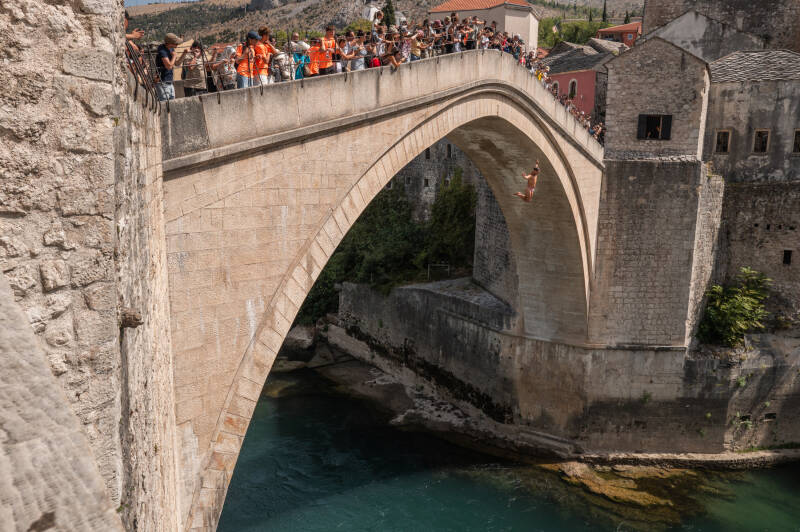
Tourists view as a diver jumps from Stari Most bridge, Mostar.
The winding roads, the single carriageways that take you from the peripheries of the country to the main cities in Bosnia are all too similar. It’s a place with gushing waterfalls, Turquoise lakes, all now the domain of hundreds of tourists. Around 80% of the territory is mountainous or hilly, with views that can rival many places on earth. What Bosnia lacks is true access to the ocean. For what it has been given is merely a token. A compensation of sorts that isn't. A glance at its map reveals its pain, a split that is visible even on tablets and computer screens, revealing the history it has been through. It is impossible to travel without encountering its wounds. I have often wondered how neighbours would have turned against each other, how those escaping persecution would have been left on their own, to fend helplessly with what little they had left. Mass deportations for three years between the war forced displacement, Killings that led to mass graves, hidden by intent. People rounded up and transported by vehicles once used for daily commutes to work or to places of leisure they would have held so dear to their hearts. Never to return. Hundreds of thousands of houses still stay abandoned.
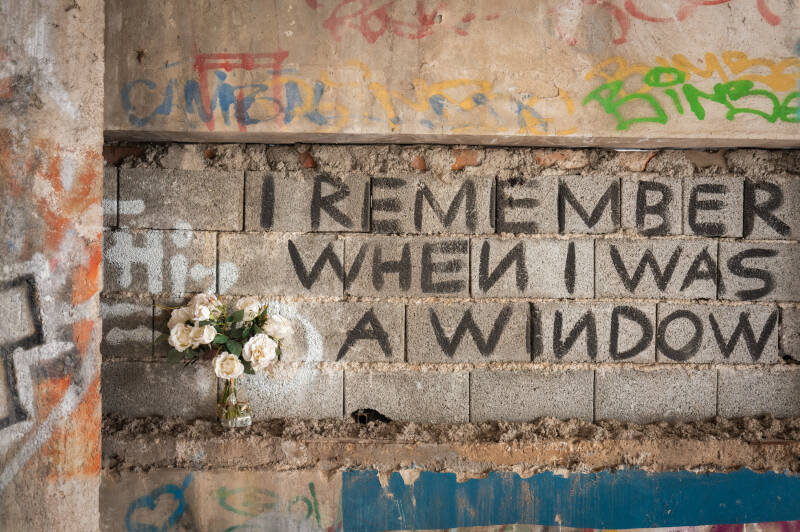
Graffiti inside Sniper Tower, Mostar, 2026.
According to international statistics, between 1 and 1.3 million people were uprooted through ethnic cleansing. A census recorded in 2013 revealed more than 540 completely uninhabited villages. The village of Rizvanovici is known to have fallen from 4000 residents to just 263. The sad part is that these stories are not unique. Across the country, Bosnians disappeared; many never returned, and many were later found in mass graves.
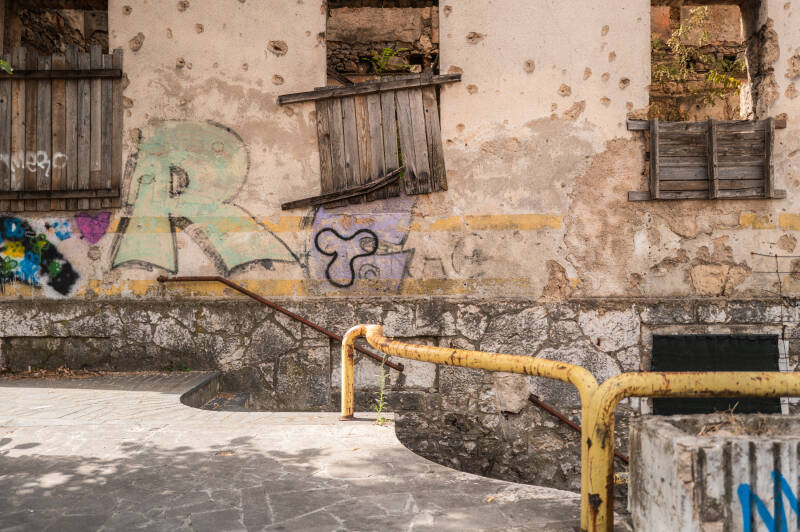
Remnants of Genocide, Bosnia 2026.
Thirty minutes from Mostar, I visit a quaint traditional village. The cobblestone hillside path here gradually weaves its way to a 15th-century mosque. Even this village wasn’t spared from what happened during the genocide. Its roof bombed, the minaret turned into rubble, and for nearly 12 years, the building lay in ruins. Until finally, with the help of international organisations and local groups, the village, together with the mosque, was slowly brought back to life, yet it took more than a decade after the end of the aggression to rebuild. Perhaps life here is an imperfect word. While minarets stand with replaced stones and repurposed wood, what is missing are the souls that will never return, generations lost, children snatched, the innocence of youth robbed of its future. The painful stories of rape and the monstrosity caused by man are all too horrific to narrate.
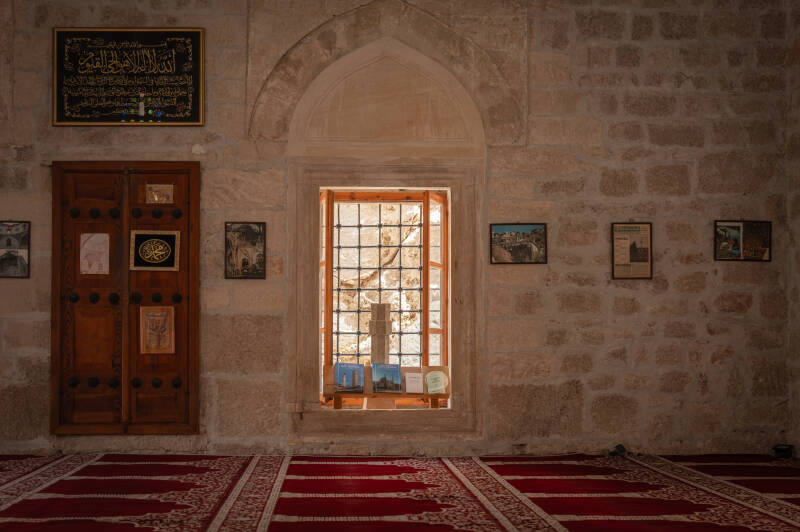
Inside an Ottoman-era mosque, Bosnia.
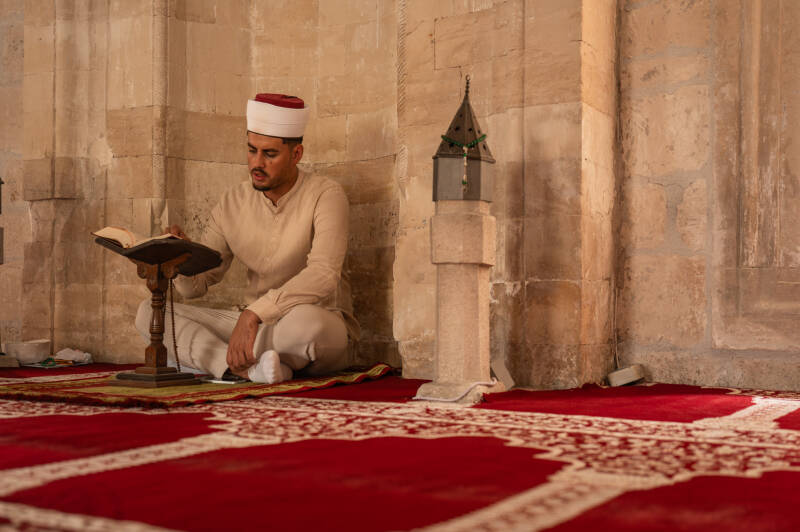
Imam Waheed-Ud-Deen at Mosque near Mostar.
Walking through the narrow alleyways, I wonder what lies behind each door. I wonder what those inhabiting these houses feel about the abandoned homes next door. Where the roofs have caved in from explosions, where bullet holes are all too visible. I wonder if they think often of those who once lived there, when they would have met in the shade of the oak tree. Perhaps where lovers would have exchanged poems in the breezy summer evenings. Or perhaps, when not long ago, they would have had a neighbourly chat over a cup of Bosnian coffee.
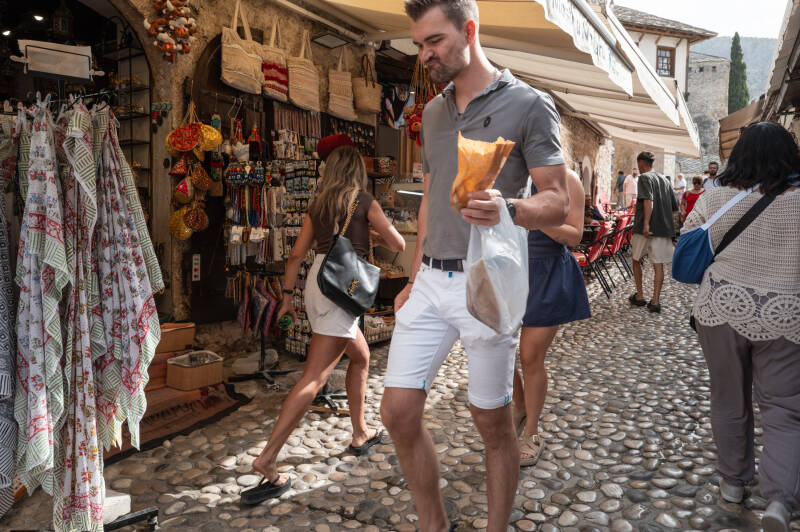
Street scene, Mostar 2026.
In the shade of the mosque in this village today, I found peace, a much-needed escape from the intense summer sun outside; the inside offered much-needed tranquillity. I couldn't help but notice the resilience of those coming to pray, locals of an age who would have witnessed first hand. The pain they would carry in silence. Today, life in this quaint village is limited to the influx of tourists. Stalls selling fridge magnets, scarves, copperware and more. Restaurants serving Ice-cold drinks, even alcohol, on sale. That alone is a testament to the tolerance found in the far corners of Bosnia that was always meant to be. Sarajevo itself was known as the Jerusalem of Europe. But perhaps, like the Jerusalem of today, it too remembered that it was once a window to a fate similar to its namesake.
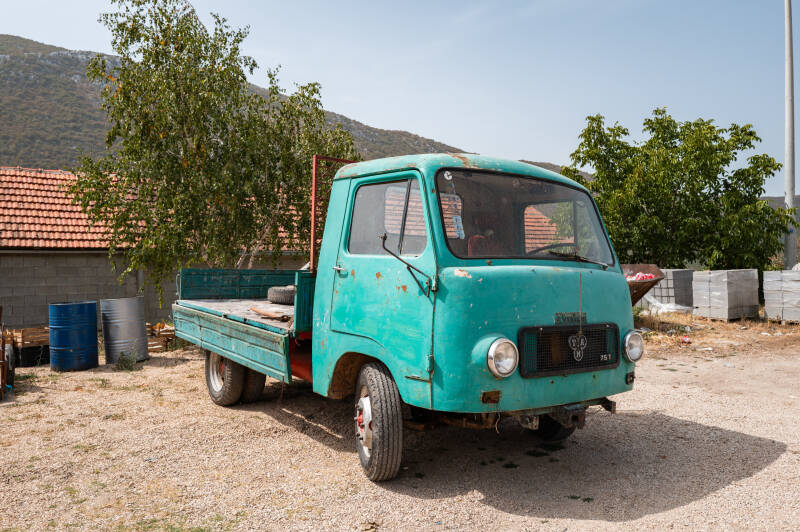
Keeping it alive, Truck 2026, Bosnia.
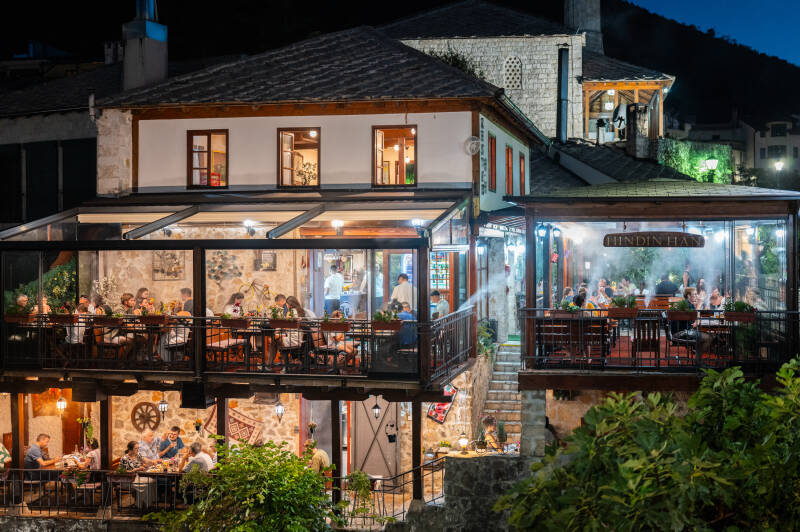
Restaurants at night, Old Town Mostar, August 2026.
Thank you for viewing this article and photo essay. Please like and share to show your support.
You can see more photography by Sajad Ahmad at these links: https://sajadahmad.co.uk Instagram: SAhmadPhoto